
Let’s say you just stepped into a leadership role, or you only want to brush up your skills, and you have no idea where to start. I’ll start with the basics, which is where everything should start.
Thomas Aquinas, one of the greatest philosophers who ever lived, wrote back in the 13th century, in a list of 16 pieces of advice he left as guidance for the pursuit of knowledge:
“Enter the sea through the streams, not directly, for it is through what is easy that one reaches what is hard.”
So let’s not rush. Here I want to talk about two things: the role of self-knowledge and what it actually means to be a leader.
Know yourself first

Before you try to lead, you have to know yourself first. You will never lead effectively without first having a firm grip on who you are. And why does that matter? It matters because leadership is a two-way street between leader and led, and when you don’t know yourself, a good part of your reactions will run on autopilot, especially when there’s emotion involved (and make no mistake, there will be plenty of those).
To be more practical, start by asking yourself the following questions and write down the answers:
- What gets you excited?
- What makes you angry?
- What do you value?
- What behaviors do you admire in people?
- How do you react when you’re nervous?
- How do you react when you’re happy?
- What disappoints you?
- How do you learn?
- How do you like to receive feedback?
- Do you prefer a calmer or a busier environment?
Once you’ve answered, go through each one calmly and reflect on how they might shape your relationship with the people you lead. Looking at the answers, do you notice any obvious room for improvement? If so, what is it?
More important than the answers themselves is realizing that these are your answers, not the answers of anyone you lead. In other words, what disappoints you may not be what disappoints someone you lead. The way you learn may be completely different from the way they learn. It’s essential to keep in mind that we deal with people, and people are unique and complex. There’s no magic formula for leading. The best way to lead one person can be completely different from the best way to lead another. And that’s fine! Each one is made of their own personality traits, their stage of emotional maturity, their beliefs and values, their social skills, their cognitive biases. So don’t expect a ready-made script teaching you how to lead. And if someone is selling you that, they’re lying.
What does exist are good leadership practices, frameworks that have been tested and validated, and that always factor each person’s individuality into how they’re applied. Otherwise, no matter the method, it’s bound to fail.
A good analogy is to think of a soccer team. A coach can teach everyone the rules of the game, the techniques, the best way to do A or B. But in a real match, the team will always have to adapt to its opponent. The style that works very well against one team can be a total disaster against another. And don’t get me wrong, it’s not that the person you lead is your opponent. The point here is to understand that there’s no silver bullet and no ready-made recipe, and that one of the most important skills of any leader will always be adaptability.
The definition of a leader

With the role of self-knowledge out of the way, let’s move on to what a leader is, and more specifically, what makes a good one.
A dictionary gives two interesting definitions for a leader:
- A person with the power to decide, to make others obey;
- A person with the ability to influence the ideas and actions of others.
Even though they define the same thing, it should be clear that the two point to very different ways of leading. The first is an almost “command and control” approach, where whoever can, commands, and whoever is sensible, obeys. The second points to a more inspirational leader: “a person with the ability to influence”. Notice that the ability to influence doesn’t depend on the leader alone, but also on the led. Someone who prefers to be led with direct, practical orders may not care about having an inspirational leader, and certainly doesn’t care whether the leader has the ability to influence or not. For that kind of person, you are the leader, and that’s enough.
To make the two approaches a bit clearer, we can think of a military setting as a good example of a place with leaders who hold the power to decide. Everything comes down to rank: whoever holds the higher one commands whoever holds the lower one. This is, of course, just a simplification for the sake of the example, and in the military there can absolutely be leaders who fit the second definition, with the ability to influence ideas and actions.
And don’t think either definition is wrong. Both work and are, relatively, correct. The main point is to understand that the way you lead should be the result of an agreement between leader and led. Since leadership always involves more than one person, it’s only fair that everyone agrees on the chosen format.
So ask yourself: what is a good leader to you?
Then put the same question to the people you lead. So everyone feels more comfortable, let them answer anonymously, in a simple form.
Once you have everyone’s answers, pull out the common terms (or set predefined options to pick from) and look at the ones that come up the most. You might end up with something like this:
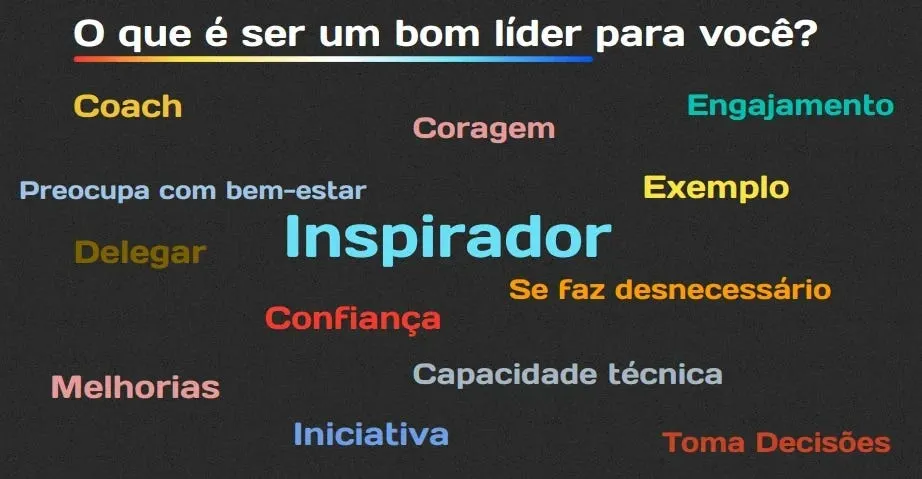
If the term that shows up the most is “inspiring”, or something close to it, that gives you a good idea of your team’s preferred style of leadership.
After analyzing their answers, compare them with yours. Are leader and led aligned on how they want leadership to look?
Where to start
Before any technique or framework, start with yourself. Reread your answers to the questions above calmly and try to notice how they shape your relationship with the people you lead.
And, as an exercise, write down your emotions while you’re at work. Notice how you react to what happens and what emotions it stirs in you. It’s rich material for getting to know yourself better. Leadership has no finish line; it’s continuous improvement, and it starts with the person leading. Once you’ve started with yourself, the next foundation is the team, and it stands on one thing: trust is the foundation of good teams.